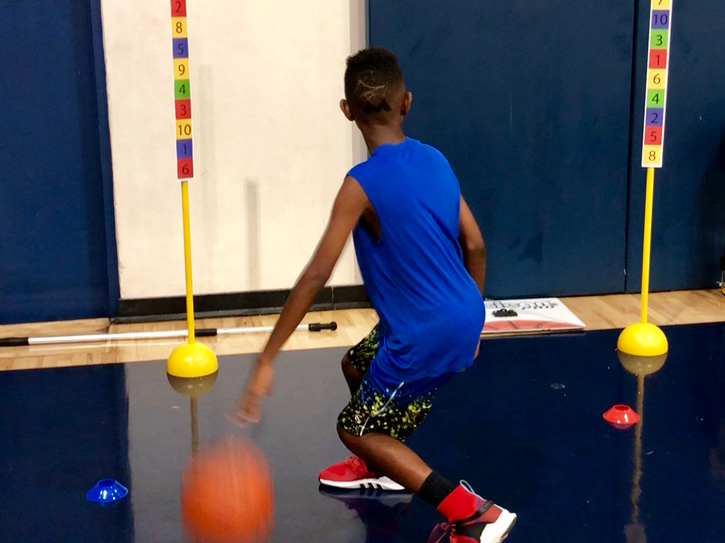
Athletes know that the key to making game-winning decisions under pressure starts with having good situational awareness.
Vision accounts for 80 percent of all sensory information that the brain receives, and a high-stress sports competition can push the limits of the brain’s ability to see and perceive what’s going on. But processing sports scenes comes down to two fundamental visual skills, identifying objects and identifying motion.
Seeing a detailed visual scene is largely an optical illusion. Of the 240 degrees in our visual field, only the central three degrees are capable of seeing 20/20 or better. That’s less than two percent of our vision. So how come our world is full of sharp detail all around us? Our eyes are constantly moving that central spot, mostly unknown to us, to construct the world we perceive.
Building the external visual world is very taxing to the brain. We use a precise and rapid visual scanning technique called saccades to get all the necessary information to understand situations around us. In sports, even more precise and faster scanning is needed. But the catch is that while our eyes scan to the next point they briefly shut off so we don’t see any blur as they move. To show this, quickly dart your eyes from far left all the way to the right and you might see a brief moment where your vision turns off.
When it comes to sports vision, most of what we see is moving, and darting our eyes around more means we have more moments of blindness. When it comes to the constantly changing scenes in a sporting event, looking in the right place at the right time is paramount. Research shows that elite athletes not only move their eyes more accurately, but also use fewer eye movements and focus on each spot slightly longer. So amateurs and novices scan more points, but actually perceive less of the world around them. The reason is those longer pauses, or fixations, in the elite athlete. When the eyes are still, the peripheral vision can expand and your brain has a better idea of what’s going on around you.
This brings us back to the 98 percent of our vision that isn’t responsible for detail, but instead accounts for picking out objects in our surrounding field of view. Although this peripheral vision is blurry, it’s much better at detecting motion and positioning. This is how we get a large amount of information regarding movement patterns and our own movement in relation to our sports environment.
Elite athletes learn to centralize their focus to important visual points, and fixate on them, to actually take in more visual information. This is how they can spread their attention and keep track of what’s going on around them at all times, which leads to less blurring in the heat of action and a greater awareness of how a play is changing from moment to moment. This is the ultimate visual-perceptual-cognitive skill that gives athletes an almost sixth sense of awareness.
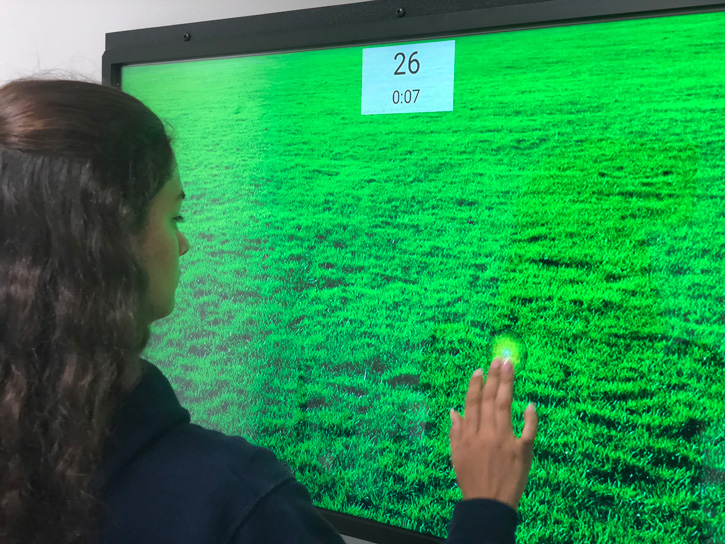
Visual search skills as well as peripheral awareness and recognition can be honed through sports vision training. For instance, a “visual pivot” is a technique to improve search skills and peripheral vision by teaching you to anchor your focus and consciously pay attention to what’s going on around it. Basically you’re centralizing your gaze and spreading your mental attention.
Sports can deliver an overwhelming amount of visual information, and the brain’s ability to perceive and process this information can be improved. One goal of sports specific visual training is to increase the bandwidth for vision so more information in a sports scene can be understood and used at any given moment.
Article written by Dr Adam Clarin, Clarin Eye Care.












 Deering Estate
 Massage Envy South Miami
 Calla Blow Dry
 My Derma Clinic
 Sports Grill
 The Healthy Kitchen
 Sushi Maki
 Golden Rule Seafood
 Malanga Cuban Café


 Kathleen Ballard
 Panter, Panter & Sampedro
 Vintage Liquors
 The Dog from Ipanema
 Rubinstein Family Chiropractic
 Your Pet’s Best
 Indigo Republic
 Animal Health and Rehab
 Maurice’s Jewelers
 ATR Luxury Homes


 2112 Design Studio
 Hamilton Fox & Company
 Creative Design Services
 Best Pest Professionals
 HD Tree Services
 Trinity Air Conditioning Company
 Cisca Construction & Development
 Mosquito Joe
 Cutler Bay Solar Solutions


 Miami Royal Ballet & Dance
 Christopher Columbus
 Pineview Preschools
 Westminster
 Carrollton
 Lil’ Jungle
 Frost Science Museum
 Palmer Trinity School
 South Florida Music
 Pinecrest Orthodontics
 Dr. Bob Pediatric Dentist
 d.pediatrics


 South Miami Women’s Health
 Endodontix Dental Group
 The Spot Barbershop
 My Derma Clinic




 Miami Dance Project

 Rubinstein Family Chiropractic
 Indigo Republic

 Safes Universe
 Vintage Liquors
 Evenings Delight





 Atchana’s Homegrown Thai
 Baptist Health South Florida

 Laser Eye Center of Miami
 Visiting Angels
 OpusCare of South Florida



 Your Pet’s Best

 HD Tree Services
 Hamilton Fox & Company

 Creative Design Services